There Will Be No Forgetting — Khamenei’s Funeral Turns into a Vow of Revenge Against America and Israel
In the silence after the war, Iran sends off its slain leader as a symbol of state endurance, historical pain, and a vow that will not fade
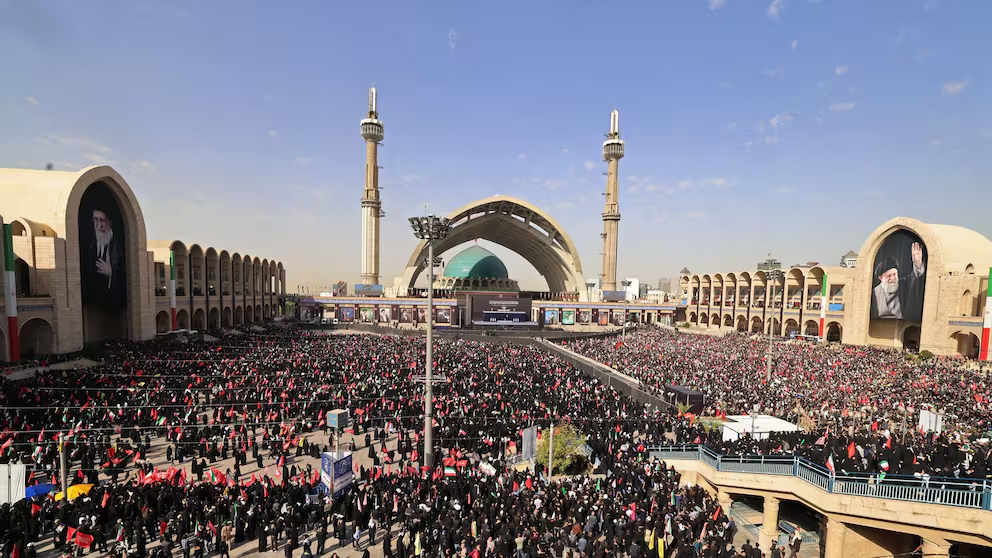
Tehran today became the center of a massive national farewell for Ayatollah Ali Khamenei, Iran’s supreme leader killed on February 28 in American-Israeli airstrikes that started the war against Iran. The funeral procession, which set out from the great Mosalla prayer complex, turned into a mass demonstration of grief, defiance, and political unity. Iranian sources speak of millions of people in the streets of the capital.
The coffin of the slain leader, along with those of family members who died in the same strikes, was carried through the city on a large truck. Among the dead were Khamenei’s daughter, her 14-month-old child, one of his sons-in-law, and the wife of Mojtaba Khamenei, Iran’s new supreme leader. Fire hoses sprayed water over the crowd to protect the masses from the heat, while Iranian flags, black banners of mourning, and red banners calling for revenge for the slain leader fluttered above the procession.
The anger of the crowd was clearly directed at the US, Israel, and their allies. Protesters threw stones at a large poster depicting US President Donald Trump with a bullet aimed at his head. “The US killed our father. We will not let you go,” the poster read.
American and British flags were burned, and some banners carried direct threats against Trump and other American and Israeli officials.
President Masoud Pezeshkian tried to steer the tone of national mourning toward a message of internal unity. In a post on X, he said the slain leader had “taught everyone” that Iran’s greatest strength is its people and their unity. “Through compassion, solidarity, and sincere service to the people, we will continue the path of Iranian dignity, progress, and pride,” Pezeshkian said.
Judiciary chief Gholam Hossein Mohseni-Eje’i spoke along the same lines, saying that the slain leader’s ultimate goal had been to remove corruption and “arrogant powers.” Commenting on the calls for revenge, he stressed that the Iranian people do not seek revenge out of hatred, but action against the perpetrators so that war crimes are not repeated.
Particular attention was drawn to the fact that Mojtaba Khamenei, the slain leader’s son and his successor as supreme leader, did not appear in public. Some believe he might appear on Thursday, when the burial is scheduled. On Sunday, three sons of the slain ayatollah prayed by the coffin, but Mojtaba was not among them.
Funeral ceremonies began as early as Friday, when the coffins were put on display for Iranian officials and foreign delegations. According to Iranian media, delegations arrived in Tehran from a number of countries, including Russia, China, India, Pakistan, Iraq, Tajikistan, and Turkey.
The ceremonies continue even after the Tehran procession. The slain leader’s body is expected to be transferred to Qom, Iran’s center of Shia religious education, then to the Iraqi holy cities of Najaf and Karbala, before returning to Iran for burial on July 9 at the Imam Reza shrine in Mashhad, in accordance with his will. This places Khamenei’s death symbolically within the broader Shia historical framework of sacrifice, martyrdom, and resistance.
The war has for now been halted by a preliminary peace agreement reached last month. Iran claims it emerged from the war as the victor, since its political system survived, and its ability to influence global energy flows through the Strait of Hormuz has become even more apparent. Trump also claims victory, although the goals he stated at the start of the war — destroying Iran’s nuclear and missile capabilities, removing Iran’s ability to attack its neighbors, and creating conditions for the fall of the government in Tehran — clearly were not achieved.
Israel, on the other hand, shows no intention of abandoning its policy of targeted killings. Israeli Defense Minister Israel Katz said the elder Khamenei was killed because, according to Israel’s interpretation, he was leading a program to destroy Israel, adding that any Iranian leader who again goes down that path will also be killed. Such statements further reinforce the belief in Tehran that it is facing not just one war, but a long-term strategy to eliminate the Islamic Republic of Iran.
That is why the Tehran procession is more than a funeral. It is a message that the American-Israeli strikes did not cause collapse, but consolidation. The cries for revenge, the imagery of martyrdom, and the emphasis on unity carry a clear political message: Iran wants to show that it is turning grief over its slain leader into a new phase of resistance. At a moment when peace is being discussed, it is clear in Tehran that peace will not mean forgetting.
About the Author


Mario Hoffmann is an independent analyst and writer covering global economics, geopolitics, and international affairs. With a background in history and politics, he writes for EconoPuls to provide in-depth context on the stories shaping our world.


