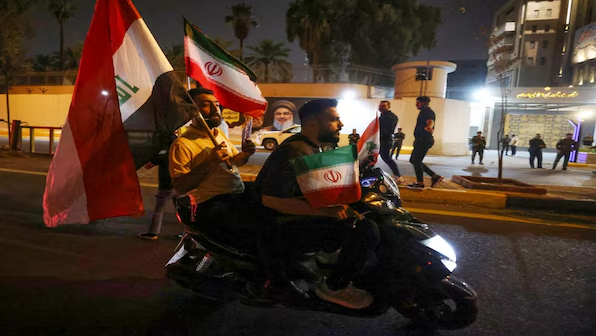
The shock rippling through the streets of Tehran resembles that of September 1980, when Iraq launched its invasion. But today’s Iranians only partially remember that time—back then, the country was largely rural and illiterate. Today, 80% of the population lives in cities.
Neighborhoods flattened in central Tehran, pillars of smoke on the horizon. On June 13, the attack that had been feared for years finally began. From the first hours, the wealthy fled the Iranian capital for their villas on the Caspian coast. Lines grew in front of gas stations and food stores. Many day laborers lost their already meager incomes and fell into poverty, while the police chief called on citizens to report “terrorists” hiding among the population.
Very quickly, the Israeli Air Force took control of Iranian airspace, destroyed—at least on the surface—nuclear research centers and missile launch sites. The attack became spectacular, eliminating scientists and decapitating the command structure of the military and the Revolutionary Guards (Pasdaran), a paramilitary force that answers directly to the Supreme Leader. Daring raids and technological superiority seemed to give Israel a decisive edge, and a week later, its American backer joined in—ready to inflict “monumental damage” to Iran’s nuclear facilities, as President Donald Trump declared.
With a population ten times smaller and a territory 80 times smaller, it was announced that David had defeated Goliath in just twelve days. Yet these victories also suggest that the threat may have been exaggerated. Iran’s military spending in 2024 amounted to only 14% of Israel’s—and that percentage continues to decline. Blows struck against Tehran’s allies—Hezbollah in Lebanon, Houthi loyalists in Yemen—revealed that much of the “Axis of Resistance” rhetoric was mere bravado. Although the Revolutionary Guard claimed it had “perfect control” over this hybrid and total war’s stage, it was unable to deliver a fatal response to a state with nuclear weapons, Western support, and U.S. military backing.
Self-Censorship No Longer Applies
The shock spreading through Tehran today recalls 1980, when Iran was in revolutionary fervor and managed to mobilize its population to retake territory seized by Saddam Hussein’s forces. But today’s Iranians only faintly recall that era—society was largely rural and illiterate. Now, 80% live in cities, most children attend school, and many young people, especially women, pursue university education.
There are now no more true believers in political Islam in Iran than there were committed communists in the USSR in the late 1980s. Despite its stability, this “mullocracy”—a regime with a democratic façade where clerics hold real power—has lost much of its legitimacy. The brutal suppression of the “Woman, Life, Freedom” movement in 2022 further shook the nation, following the 2019 crackdown on protests over rising living costs.
But self-censorship is gone. In the weeks leading up to the Israeli attack, Iranians were no longer afraid to speak out. The government was forced to bend. On December 15, it repealed a new repressive law on “veils and chastity.” In urban areas, more than a third of women now go uncovered. Even more surprising, this is evident in some government institutions.
The Western media’s caricatured image of “divine madmen” shouldn’t obscure the fact that the regime understands power dynamics well and can act pragmatically. In 1988, revolutionary founder Ruhollah Khomeini agreed to a ceasefire with Iraq. His successor, Ali Khamenei, signed the 2015 Vienna nuclear agreement with the five permanent UN Security Council members, Germany, and the EU. In March 2023, China brokered a normalization of diplomatic ties between Iran and Saudi Arabia. In July 2024, the Supreme Leader did not oppose the election of “reformist” Masoud Pezeshkian as president—a man who represents two key ethnic minorities (his mother is Kurdish, his father Azerbaijani).
Netanyahu’s Gamble – and the Regional Fallout
By justifying war with Iran’s nuclear program, Benjamin Netanyahu took major risks—none greater than the threat of a wider regional conflict. IAEA Director General Rafael Mariano Grossi warned that nuclear infrastructure must never be targeted: “These attacks have serious implications for nuclear safety, security, and safeguards, and also threaten peace and stability in the region and beyond.”
Iran now has no more genuine supporters of political Islam than the USSR had of communism in the 1980s. Though still stable, its clerical regime has lost much of its legitimacy.
The goal of destroying Iran’s medium-term bomb-making capacity is unlikely to be achieved. Strikes may have damaged facilities but left enriched uranium stockpiles untouched. Only an international monitoring system can ensure a true halt to the program. If the aim was to bring Iran back to the negotiating table, why did Donald Trump torpedo the Vienna deal in 2018, only to attack Iran mid-negotiation?
The G7’s blanket support for Israel seems irresponsible in the context of nuclear nonproliferation. Twenty key Arab-Muslim states, excluding Iran, jointly emphasized the urgency of creating a nuclear-weapon-free zone in the Middle East, applicable to all countries without exception. This is clearly aimed at Israel, which has not signed the Nuclear Non-Proliferation Treaty (NPT). Powers like Turkey, Saudi Arabia, or Egypt may now consider how best to shield themselves from Israel’s unchecked interventions.
“Reliance on force instead of diplomacy is the surest way to destroy the NPT; it signals to many nations that developing nuclear weapons is the only real security guarantee,” warned Mohamed ElBaradei, former IAEA director, on June 18 via X (formerly Twitter).
“Awakening the Lion”: Echoes of Regime Change
The name chosen by Israel for the offensive—“Awakening the Lion”—reveals its intentions. The solar lion, once the symbol of royal Persia, was removed from Iran’s flag after the 1979 revolution. This regime change strategy recalls the 1953 coup backed by Britain and the U.S., aimed at halting oil nationalization and restoring the Shah, Mohammad Reza Pahlavi. His exiled son, who enjoys longstanding Israeli support, holds sway in parts of the diaspora and satellite media. But bitter memories of the Shah’s infamous secret police, Savak, tarnish his legitimacy. The same applies to the MEK (Mujahedin-e-Khalq) opposition group’s past alliance with Saddam Hussein, which continues to undermine their credibility.
Despite foreign powers seeking to destabilize Iran, there is no sign the state is on the brink of collapse.
In recent months, many Iranians seemed ready to do whatever it took to end the regime. But the Israeli offensive may shift public opinion. The day after June 13, even social media accounts that relentlessly criticized the clerics began posting maps of Iran. “I’d rather die than be a traitor,” said former football star and outspoken regime critic Ali Daei, rejecting any cooperation with foreign powers.
No Real Allies
Key figures in the reformist camp—many under house arrest or surveillance since the 2009 Green Movement—condemned the offensive in unambiguous terms. Zahra Rahnavard, wife of former prime minister and contested 2009 presidential candidate Mir-Hossein Mousavi, stated to IRNA:
“The criminal hand and aggressive nature of Netanyahu, in blatant violation of all international norms, strike our nation with military blows that target infrastructure, scientists, and even the lives of innocent civilians—men, women, and children.”
From prison, Mostafa Tajzadeh, former deputy interior minister under President Khatami (1997–2005), managed to send a message:
“Supporting foreign military aggression—by a power accused of war crimes by the International Criminal Court—is politically and morally indefensible. Even if this war toppled our dysfunctional religious regime, Iran would be left in ruins, likely ruled by anarchy and chaos.”
He advocates for a peaceful transition to democracy through a constitutional assembly. Aggression, on the other hand, empowers the current regime to intensify repression and suppress social movements.
Still, one telling anecdote: after women appearing without headscarves post-June 13 began receiving warning texts, the head of the government’s information service quickly apologized, calling it a “systemic error.”
More than a third of women in cities no longer wear a headscarf—visible even in some government offices.
Several independent organizations, including the bus drivers’ union and a retirees’ association, denounced Israeli lies:
“We have no illusions that the U.S. or Israel would bring freedom, equality, and justice—just as we have no illusions about the Islamic Republic’s repressive, interventionist, adventurous, and anti-worker nature.”
Regional Reactions and What Comes Next
In contrast to Western leaders gathered at the G7 summit in Canada, Turkish President Recep Tayyip Erdoğan stated that:
“Netanyahu has once again shown that he is the greatest threat to regional security. Iran has every natural, legitimate, and legal right to defend itself against Israeli brutality and state terrorism.”
All 57 members of the Organization of Islamic Cooperation, backed by many Global South nations, condemned the attacks unanimously. Though these positions may encourage Iranians, the reality remains: Iran has a few friends like Russia and China, but no formal ally willing to offer military support.
After initial panic, life continues under the bombs—marked by exhaustion and fear. Basic supplies remain sufficient for now, but internet access is frequently disrupted. Increased pressure on the regime risks pushing it toward radical measures already debated in parliament: blocking the Strait of Hormuz, withdrawing from the NPT.
A return to negotiations after a ceasefire might at least bring some relief to the Iranian people.
About the Author


Mario Hoffmann is an independent analyst and writer covering global economics, geopolitics, and international affairs. With a background in history and politics, he writes for EconoPuls to provide in-depth context on the stories shaping our world.


