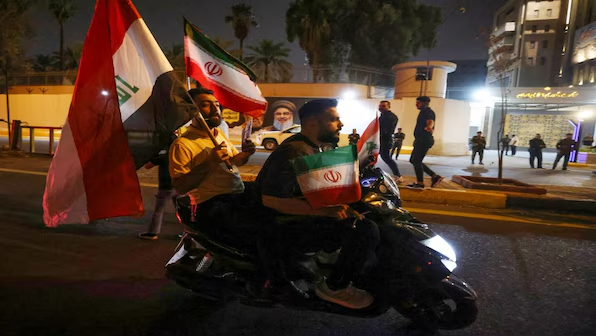
The situation is relatively calm. Initial reports from U.S. agencies suggest that damage to Iranian facilities is significantly less than President Trump’s claims, which the White House strongly denies
American airstrikes did not destroy Iran’s nuclear capabilities but only temporarily set them back, according to a preliminary assessment by the U.S. intelligence community. This comes just as a fragile ceasefire between Iran and Israel, personally brokered by U.S. President Donald Trump, came into effect. After nearly two weeks of intense military operations, both countries signaled that the air war is, at least for now, over.
Although both Iran and Israel have begun lifting civilian restrictions after 12 days of conflict that claimed hundreds of lives, each side rushed to present its version of victory. Over the weekend, Trump stated that the U.S.’s use of heavy bombs had “destroyed” Iran’s nuclear program. However, three sources familiar with an internal U.S. intelligence report say the reality is far more complex: the nuclear material was not eliminated, and most of Iran’s program—much of which is located deep underground—was likely only delayed by a few months.
A report by the Defense Intelligence Agency (DIA) suggests that the U.S. strikes blocked access to two key facilities but did not destroy the underground structures. Some uranium enrichment centrifuges remained intact, according to the Washington Post, citing an unnamed official. Meanwhile, the White House rejected these claims, calling the report “completely inaccurate.”
Despite differing interpretations of the strike’s effectiveness, the Trump administration informed the United Nations Security Council that the attacks had “degraded” Iranian capabilities—a softer formulation than the president’s earlier declaration of “total destruction.”
Israeli Prime Minister Benjamin Netanyahu stated on Tuesday that the attack on Iran had eliminated the “threat of nuclear annihilation” and added that Israel would prevent any attempt by Tehran to rebuild its program. “We have removed two immediate existential threats: the threat of nuclear annihilation and the threat of 20,000 ballistic missiles,” Netanyahu said.
On the other hand, Iranian President Masoud Pezeshkian declared that Iran had “successfully ended the war,” calling it a “great victory.” According to the state news agency IRNA, Pezeshkian expressed readiness to reduce tensions with Washington during a conversation with the Saudi Crown Prince.
The conflict erupted on June 13, when Israel launched surprise airstrikes on Iranian nuclear facilities, killing several high-ranking military officials—the most significant blow to the Islamic Republic since the war with Iraq in the 1980s. Iran responded with a massive missile barrage targeting Israeli military sites and cities. It was the first time Iranian missiles breached Israeli air defenses in such numbers.
By Tuesday evening, the Israeli military lifted movement restrictions within the country, and Ben Gurion Airport was reopened. Iranian airspace was also reopened, confirmed by state media. The White House announced that Trump personally negotiated the ceasefire with Netanyahu, while his aides simultaneously communicated with Tehran.
Despite the declared ceasefire, both sides continued to accuse each other of violating the agreement. Early in the morning, Trump sharply criticized both sides but singled out Israel for, in his words, “dropping a whole load of bombs” right after the deal was struck.
“Israel needs to calm down,” Trump told reporters outside the White House before departing for the NATO summit. “Israel and Iran have been fighting for so long and so hard that they don’t even know what the hell they’re doing anymore,” he said.
The office of the Israeli Prime Minister later admitted that a radar near Tehran was hit in response to what they claim was Iran launching missiles three and a half hours after the official start of the ceasefire. Tehran denied this and accused Israel of continuing its attacks more than an hour and a half after the agreement was supposed to take effect.
Ultimately, the question remains whether the ceasefire will hold, given the deep mistrust between the two sides. Israeli Chief of General Staff Eyal Zamir said that a “significant chapter” of the conflict had ended but emphasized that the fight against Hamas in Gaza remains a priority.
Iran stated that it had delivered “devastating blows” and warned the U.S. and Israel to learn their lesson. According to Iranian figures, Israeli strikes killed 610 people and injured nearly 5,000. On the Israeli side, around 30 people were killed, according to Israeli sources.
Financial markets responded positively. Oil prices fell, and stock markets rose, signaling investor relief over the avoidance of broader escalation and a potential disruption of oil supplies from the Persian Gulf. Still, this ceasefire may only be a lull—not the end.
About the Author


Mario Hoffmann is an independent analyst and writer covering global economics, geopolitics, and international affairs. With a background in history and politics, he writes for EconoPuls to provide in-depth context on the stories shaping our world.


