What is Buddhism really—and why is this ancient philosophy so relevant today?
When exploring the great philosophies throughout human history, we often find that each has a central theme by which it becomes known and remembered. For Confucianism, it’s rituals; for Taoism, harmony with nature; and for Buddhism—it’s suffering. Really? Is that the first association? Actually, yes. But don’t let that scare you. No one has ever dissected suffering as thoroughly as the Buddha did. His teaching is the ultimate guide on how to transcend suffering, even though it is so prevalent in all our lives.
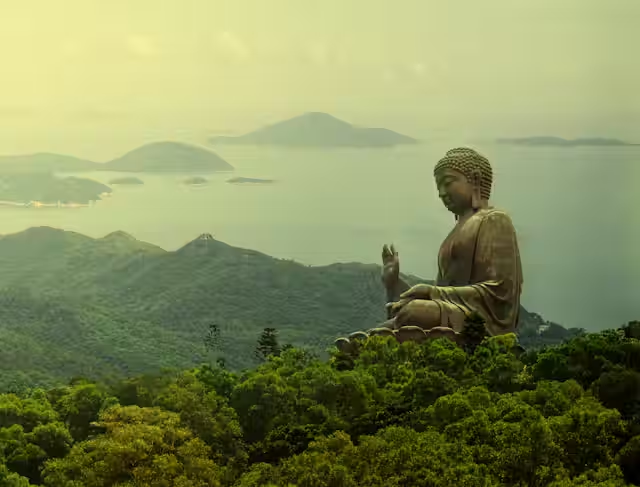
But isn’t Buddhism usually associated with peaceful, shaved-headed monks meditating in serene temples overlooking the elevated mountain ranges of Asia? Absolutely. All the more reason not to fear that suffering is the central theme of Buddhist teaching. Because this isn’t a story about suffering—certainly not surrendering to it—Buddhism is a form of resistance to suffering in perhaps the only way a human being can genuinely confront something so all-encompassing.
Like other great Eastern teachings, Buddhism sits between religion and philosophy, perhaps leaning more toward religion compared to Confucianism and Taoism. However, Buddha is not a god, and his teaching—setting aside reincarnation and karma (some Buddhist branches have distanced themselves from those)—lacks supernatural elements. In fact, Buddhism is deeply grounded and concerned with what is universally worldly.
If we approach philosophy practically—seeking knowledge and wisdom to apply to our fast-paced modern lives—we don’t necessarily need mythology. However, with Buddhism, an exception must be made. The story of the Buddha, Siddhartha Gautama, is essential to understanding his approach to overcoming human suffering.
There’s enough historical evidence to suggest that a man named Siddhartha Gautama did live in India (in present-day Nepal), became a great teacher, and was later called the Buddha—“the awakened one.”
From Royal Palace to Tree of Awakening
He was born into a royal family and destined to become a ruler. His father ensured he grew up isolated from the world outside the palace. Siddhartha lived in luxury and didn’t lack anything. However, his insatiable curiosity began to grow, and one day he asked to leave the palace grounds. What he saw changed everything.
Outside the palace, he encountered things he had never seen before: a sick person, an old person, and a dead body. Until then, he didn’t even know such things existed. After seeing these forms of human suffering, he asked a simple question—is there a way to overcome this? His desire to find the answer led him to abandon the palace, all luxury and privilege, and embark on a spiritual quest.
For years, he studied under various gurus, practiced meditation and asceticism, and even lived in extreme deprivation, to the point where his ribs were visible and his body skeletal. But none of these paths brought the answer he sought.
Eventually, he sat beneath a tree—later known as the Bodhi Tree—and vowed not to move until he attained full understanding. After days of deep meditation, he reached enlightenment.
He realized that suffering is an inseparable part of life, but that liberation from suffering is possible. He then began to teach others the insights he had gained.
The Four Noble Truths
Everything the Buddha taught stems from one central insight: suffering exists, and it can be overcome.
He articulated this through what became known as the Four Noble Truths, the foundation of all Buddhist thought:
- The Truth of Suffering (Dukkha) – Life contains suffering. This includes obvious pain, but also subtle dissatisfaction, impermanence, and emotional unease.
- The Truth of the Origin of Suffering – Suffering arises from desire, attachment, and ignorance. We suffer because we cling to what is impermanent and expect it to bring lasting happiness.
- The Truth of the Cessation of Suffering – It is possible to end suffering by letting go of craving and attachment. This state of liberation is called Nirvana.
- The Truth of the Path to the Cessation of Suffering – There is a path that leads to the end of suffering, known as the Noble Eightfold Path.
Each of these truths is not meant to be accepted blindly but to be experienced and understood personally. Buddha was not a preacher of dogma—he was a guide who encouraged direct insight through practice.
The Noble Eightfold Path
The Buddha’s path to liberation from suffering is summarized in eight principles. Together, they form the Noble Eightfold Path, which is typically grouped into three categories: wisdom, ethical conduct, and mental discipline.
1. Right View
Understanding the nature of reality, especially the Four Noble Truths. It is the insight that suffering exists and can be overcome.
2. Right Intention
Having the proper motivations—free from ill-will, cruelty, and desire. Cultivating compassion and renunciation of harmful thoughts.
3. Right Speech
Speaking truthfully, kindly, and meaningfully. Avoiding lies, gossip, and harsh words.
4. Right Action
Behaving ethically—refraining from harming living beings, stealing, or engaging in misconduct.
5. Right Livelihood
Earning a living in a way that does not harm others and is ethically sound. Avoiding professions that exploit or bring harm.
6. Right Effort
Putting in the effort to cultivate wholesome mental states and abandon unwholesome ones. Being persistent in personal growth.
7. Right Mindfulness
Being present in each moment with awareness and attention—whether to thoughts, feelings, bodily sensations, or surroundings.
8. Right Concentration
Developing deep states of meditative absorption (samādhi) through focused mental discipline, leading to inner calm and clarity.
This path is not linear—it’s a holistic system where all aspects support each other. It represents a practical guide to living wisely, ethically, and with inner peace.
A Philosophy for the Mind—Not a Religion of Blind Belief
One of the reasons Buddhism continues to resonate today is that it does not require faith in dogma or gods. The Buddha explicitly encouraged questioning, even of his own teachings. His approach was empirical—try it, test it, see if it works.
This makes Buddhism more a science of the mind than a traditional religion. It doesn’t ask, “What do you believe?” but rather, “What do you experience?”
You don’t have to believe in reincarnation, karma, or cosmic justice to benefit from its core insights. Even without supernatural elements, Buddhism provides powerful tools to:
- Understand your mind
- Recognize harmful thought patterns
- Build inner peace regardless of external chaos
That’s why so many people in the modern world—scientists, psychologists, philosophers, and everyday seekers—continue to draw from Buddhist wisdom. It’s timeless, practical, and profoundly human.
Why Is Buddhism So Popular Today?
Because it speaks to modern problems. Stress, anxiety, identity crises, burnout—Buddhism not only recognized these conditions 2,500 years ago, but also provided a system for working through them.
We live in an era where:
- We are bombarded with information yet feel disconnected.
- We chase success but often feel empty once we achieve it.
- We are more materially secure than ever before, but emotionally more fragile.
Buddhism doesn’t promise a life free from difficulty. It offers something more realistic and more powerful—a method to stop being at the mercy of external conditions and to find peace within ourselves.
This is why mindfulness, a key Buddhist practice, has exploded in popularity. Being present, observing without judgment, grounding yourself in the now—these are antidotes to modern restlessness and anxiety.
And it’s not just about calming the mind. Buddhist practice helps us reshape our entire relationship to suffering. We stop asking, “Why is this happening to me?” and start exploring, “How can I grow through this?”
From Meditation to Liberation
Central to Buddhist practice is meditation—not as a ritual, but as a tool for self-discovery and transformation.
Through meditation, we learn to:
- Observe our thoughts without clinging to them
- Witness emotions without being controlled by them
- See the impermanence of all experiences
Regular meditation trains the mind to become more focused, calm, and clear. Over time, this clarity reveals how much of our suffering is created by our own mind—by resisting change, obsessing over control, or craving what we do not have.
The ultimate goal is not to suppress thought or emotion, but to see through them—to develop insight into the nature of reality, especially the impermanent, unsatisfactory, and non-self aspects of existence (known as anicca, dukkha, and anatta in Pali).
This doesn’t lead to nihilism but to freedom. Once we stop chasing what we can’t hold onto—and stop fearing what is bound to change—we open the door to a liberated mind.
And that is the promise of Buddhism: not to escape life, but to embrace it with full awareness, compassion, and equanimity.
Buddhism Today — Ancient Roots, Modern Relevance
From the temples of Asia to Western psychology clinics, from the solitude of mountain monasteries to the chaos of corporate life, Buddhism has found a home everywhere.
And it’s not hard to see why:
- It offers practical tools for handling suffering
- It promotes inner freedom, not dependency on external saviors
- It teaches us to know ourselves deeply—and treat others with compassion
Buddhism reminds us that peace is not a place we arrive at, but a way of being we cultivate. And like any skill, it requires practice, patience, and perseverance.
In a time when so many are overwhelmed by uncertainty, fear, and division, perhaps no teaching is more radical—or more needed—than this:
Suffering can be understood.
It can be reduced.
It can even end.
Not by changing the world outside us, but by transforming the world within.
About the Author


Mario Hoffmann is an independent analyst and writer covering global economics, geopolitics, and international affairs. With a background in history and politics, he writes for EconoPuls to provide in-depth context on the stories shaping our world.


