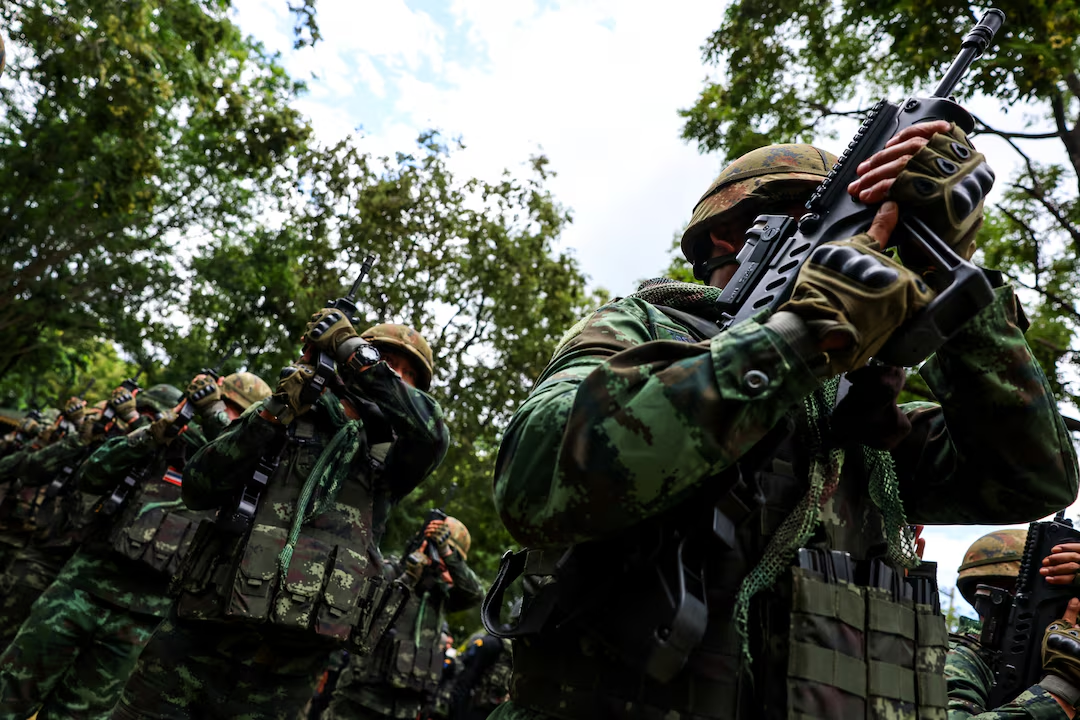
On July 24, 2025, the border between Cambodia and Thailand turned into a true warfront: around six different flashpoints—from the Ta Muan Thom temple to the rocky plateau of Preah Vihear—echoed with mortar fire and bursts from heavy machine guns. The Thai Air Force carried out at least one airstrike deep into Cambodian territory, while Phnom Penh claimed its BM-21 multiple rocket launchers had targeted attacking Thai columns. By noon local time, at least two civilian casualties were confirmed in Thailand’s Surin province, dozens of soldiers were injured on both sides, and hundreds of shells had scattered across rice fields.
The conflict stems from a long-standing border dispute that has never been fully resolved: Thailand and Cambodia interpret colonial-era maps differently at four key points—the temple complexes of Preah Vihear, Ta Muan Thom, Ta Muan Touch, and Ta Krabey, as well as the forested triangle of Mom Bei/Chong Bok. Since February 2025, several “fuses” have been lit…
Although it appeared that Bangkok and Phnom Penh were moving toward a “strategic partnership” in February last year, today’s exchange of fire revealed just how fragile borders drawn on colonial maps can be. As with every flare-up around an ancient stone temple, the issue of who has the right to land mapped by a French surveyor 120 years ago resurfaces. This time, the trigger was not UNESCO’s World Heritage list, but a peculiar combination of landmines, leaked phone calls, and a Thai domestic political crisis that, in July, led to the suspension of Prime Minister Paetongtarn Shinawatra and created a vacuum filled by the military.
Yesterday, Thailand withdrew its ambassador from Phnom Penh and expelled Cambodia’s ambassador in return. In response, Hun Manet mirrored the move and ordered all border crossings closed. Overnight, the lifeblood of the cross-border economy was severed—40,000 Thai farmers were packed into evacuation camps, and Cambodian fruit vendors were left with goods rotting in 35°C heat.
Today’s gunfire, however, came as no surprise to those following events since February, when Cambodian tourists attempted to sing their national anthem at the disputed Ta Muan Thom temple. That “singing incident” was followed by border gunfire in May near Chong Bok, then a summer wave of mine explosions, which the Thais claimed were “freshly planted, of Russian origin.” Cambodia deflected, blaming the lingering deadly legacy of Indochina, but the fact that Phnom Penh filed a case against Thailand at the International Court of Justice on June 15 over the four contested zones signaled that the Red Zone was slowly expanding.
Hun Manet, new to the prime minister’s role, is now demonstrating that he is not merely the son of Hun Sen but a capable supreme commander in his own right. In the shallow waters of Asian geopolitics, where major players watch every move, Cambodia relies on Chinese investment and military equipment, while Thailand—torn between civil legitimacy and an ever-alert general staff—finds it increasingly difficult to hide behind ASEAN’s propaganda of peaceful “centrality.” Faced with its own institutional weaknesses, the Association of Southeast Asian Nations once again responded with only a lukewarm statement urging “maximum restraint,” while Malaysian Prime Minister Anwar Ibrahim offered talks in Kuala Lumpur—an offer no one took seriously.
Schools in Thailand’s Surin and Sisaket provinces have been immediately converted into shelters with makeshift bamboo beds, while in Cambodia’s Oddar Meanchey province, women and children are fleeing toward Siem Reap, leaving behind men to guard homes marked with cloth strips so soldiers know they’ve been abandoned.
It’s important to understand that the Thai-Cambodian conflict has never been just about stone temple walls, but about sovereignty rooted in colonial ink and fueled by nationalist adrenaline. As long as political elites in Bangkok turn to war rhetoric whenever a domestic court suspends the prime minister, and Phnom Penh builds its legitimacy on military sharpness and Chinese credit lines, the old French boundary markers will remain the fuses of new crises.
There’s little doubt that this latest border firefight will eventually die down—perhaps leaving behind a few “demilitarized zones” for UN observers to wander through. But unless there is the courage to finally demarcate the border with a system that transcends colonial maps and modern-day geopolitical maneuvering, the cycle will continue. For now, the hope remains that international legal mechanisms—not new airstrikes—will draw the line after which the weapons fall silent—a line beyond which farmers can return to their fields, and the soft walls of ancient Khmer temples can once again become places of prayer, not targets in a gunsight.
About the Author


Mario Hoffmann is an independent analyst and writer covering global economics, geopolitics, and international affairs. With a background in history and politics, he writes for EconoPuls to provide in-depth context on the stories shaping our world.


